
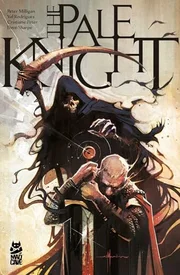

England, 1349. Sir Hugh de Grey, known as the Pale Knight, has just arrived home from his battles in France. He left behind a continent ravaged not only by war, but by plague, and he’s disheartened to find that the deadly pestilence has reached England ahead of his ship. At his estate, he finds his young son, John, dying of the disease and knows he’s being punished by God for the atrocities he has committed in France. He prays to God to spare his boy—but it’s not God that answers. Rather, Death himself appears, a shrouded skeleton with his massive scythe, to present Sir Hugh with an offer: If Hugh will enter Death’s service and kill the valiant knight Gilbert the Pure, Death will spare young John. With his acerbic squire, Crispin, Sir Hugh sets off to kill the good knight—a much better man than himself—through a landscape rapidly descending into madness. Hugh is not the only one with a moral test before him: The Jewish refugee Aaron of Albi enjoys the protection of the evil Sir Maurice Beauchamp, but only because Sir Maurice believes his Jewish magic will protect his household from the plague. Maurice’s daughter, Joan, wants Aaron to kill her father so they can run away together, but will his attempt to wield the plague for his own purposes backfire? Milligan renders 14th-century England as a disease-ravaged wasteland, brought to phantasmagoric life by the striking full-color artwork of artist Val Rodrigues. Sir Hugh and Crispin must contend with zombie-like plague victims, flagellants driven mad with zealotry, and vigilante mobs happy to burn as a witch any woman who crosses their path. Readers will find some ominous echoes of the Covid-19 pandemic, but mostly, the book serves as a wonderful piece of historical escapism, presenting the Middle Ages in all its barbarous, bubonic glory.