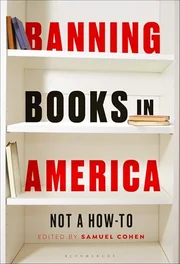

This collection of essays presents institutional, personal, and aesthetic reasons for keeping access to all publications free and open. Fiction makes us question. History pulls aside the curtain to reveal the darker players in our heroism. The novelist Jane Smiley, interviewed in the book, says, “Here’s what I always say as a writer: the first person you write for is yourself.” Emily Drabinski, a library and information studies scholar, writes, “How many of us discovered we were not alone in the pages of a book?” Jeremy C. Young and Jacqueline Allain, both with teaching experience, write, “Public universities are places where all ideas can be debated and get a fair hearing, free from ideological control by the government.” Edited by University of Missouri scholar Cohen, the book includes case studies (schools banning books by Toni Morrison) and syllabi (plans for a class based on banned books). The essays are short and conversational in tone. There is a lot of preaching to the converted, of assuming that “the social enterprise of the left is rightly the expansion of enfranchisement and equity.” Is it ever right to ban a book? Germany has banned Hitler’s Mein Kampf. Should we ban “Thomas Dixon’s noxious and reprehensible Reconstruction Trilogy of novels, whose popularity in the early twentieth century says a lot about the racialized character of American Progressivism?” Individualism and communitarianism remain two opposing forces of American society. Caring about our own and caring about others often conflict. Should we legislate against feeling bad? While there are no specific answers in this book, one contributor, scholar Leonard Cassuto, offers the most hopeful path: “If we are to find any possibility of shared interest in our troubled polity, we all might benefit from looking more closely at what the other people think.”