
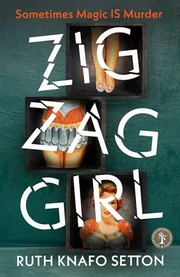

The story is set against Atlantic City’s decaying glamour. Lucy Moon, a magician born into one of America’s most famous magic families, is preparing for a career-defining performance when her co-star, Van, vanishes. Minutes later, the illusion meant to cap the night (the sawing in half of a woman) becomes real in the worst possible way: Van’s body is discovered inside the very box used onstage, transforming a classic magic trick into a crime scene. From that moment, the story moves between the investigation and its aftermath, following Lucy as she navigates grief, shock, and suspicion. The venue itself is central to the plot; the Black Widow Theatre is a historic space layered with wartime memory, corruption, and whispered legends, where performances never quite end and the past refuses to stay buried. (“Despite having only three hundred and thirty-five red-velvet seats, the Widow is grand. Chandeliers drip diamond-lights from an intricately carved sky filled with Nordic gods.”) As the police begin their work, Lucy and her closest ally, Stormie, start their own search for answers, driven by loyalty and the conviction that Van’s death will be misunderstood if left solely to official channels. The narrative steadily expands its circle of suspects and motives. Magicians, casino workers, veterans, journalists, and shadowy figures from Atlantic City’s nightlife drift in and out of focus. Lucy’s background complicates everything—her father’s fame, her aunt’s witchcraft, and her own uneasy relationship with confinement and performance all color the investigation. The plot unfolds with the precision of a stage act built around timing, misdirection, and withheld information without relying on cheap twists or shocks for momentum.
The book’s strongest element lies in how the author uses magic as metaphor. Illusion is not simply entertainment but a system of power—it’s about who controls the story, who disappears, and whose body is placed at risk. Lucy’s fear of the sawing box is symbolic of a long tradition in which women are locked inside spaces designed by men, expected to emerge unharmed and smiling. As she reflects early on, “But lock me in the box and saw me in half, and I’ll scream bloody murder.” That line echoes throughout the story, reframing the hoary illusion as an act of enforced silence. Rather than treating the supernatural as spectacle, Setton uses hauntings to explore unresolved ideas of violence and inherited pain. Ghosts and intuitions function less as plot devices than as manifestations of memory, insisting that what happened before still matters. The city itself becomes complicit, its casinos and boardwalks masking exploitation beneath neon and nostalgia. Stylistically, the prose is confident and atmospheric, grounded in tactile detail and sharp dialogue. The pacing balances urgency with emotional weight, allowing grief and anger to surface without slowing the narrative drive. Observations about gender, performance, and risk are woven into the story rather than announced, giving the book its quiet bite.