
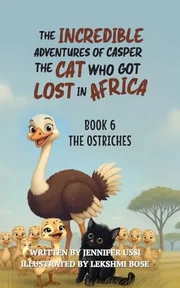

Little black housecat Casper has spent many days (and five books in her eponymous series) walking across Africa in an effort to find her way home. In this outing, she is rudely awakened, first by a competitive dung beetle, then by a group of 20 baby ostriches who can’t find their parents. The chicks’ leader, the self-effacing Felicity, asks Casper for her help in getting all 19 of her brothers to a safe haven with their cousins. The cat agrees and the group sets off, but not without turmoil: Poisonous red-headed centipedes almost sting Casper, and she is only spared by the timely intercession of the warthog Wigbert. Wigbert helps guide the group to the ostriches’ family, and Casper chooses to spend extra time with them. Casper isn’t the only interested feline—a cheetah emerges to stalk the flock. Alongside Mzee the tortoise, Casper and company must gather their courage and defend themselves against this common enemy. This early chapter book about self-confidence and cooperation will entice young readers interested in wildlife, whether they’ve read the previous titles in the series or not. The lesson about rejecting labels is cleverly and naturally woven together with animal facts, such as when Felicity worries that she isn’t intelligent because ostriches have small brains. (“‘You have to be pretty smart to know when to ask for help,’ Casper said. ‘It’s not the size of the brain, it’s how you use it.’”) Several pages of informative text and photos are included in the aftermatter, which covers every creature mentioned in the story, no matter how big or small their role. Bose’s bright, doe-eyed illustrations are cute without sacrificing too much realism.