
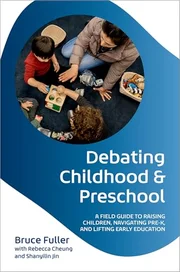

Fuller’s book, written with colleagues Rebecca Cheung and Shanyilin Jin, is a rich, carefully structured field guide to one of the most politically charged and emotionally freighted domains in education. Organized around five central questions—how childhood is defined, who shapes early education, where learning should occur, what constitutes quality, and whether preschool can reduce inequality—the book moves methodically from philosophical foundations to contemporary policy debates. It begins by examining four enduring visions of the child, from the disciplined future worker to the culturally situated learner, showing how these frameworks continue to drive today’s arguments about play, school readiness, and academic rigor. Subsequent chapters map the mixed-delivery system that now characterizes American early education, tracing the roles of unions, advocates, public schools, and private providers. Drawing on decades of empirical research, the authors examine what actually improves preschool quality, including warm teacher-child relationships, rich language exposure, and cognitively engaging activities, while also acknowledging the stubborn fade-out of early gains and the uneven evidence on long-term effects. Throughout, Fuller and his co-authors situate classrooms within broader cultural and economic contexts, emphasizing the persistent tension between standardization and pluralism. The book succeeds as a dense but accessible synthesis. The prose is calm, measured, and scrupulously evidence-based but not bloodless; the authors’ willingness to question sacred cows (“learning through play” among them) gives the analysis intellectual bite without polemical heat. Scholars will appreciate the breadth of research and conceptual framing, while practitioners and policy-curious parents will find the arguments legible and often bracing. Even when breaking down technical debates about program effects or institutional design, the authors keep the stakes human and recognizable. The result is a rigorous, evenhanded work that invites disagreement and rewards careful reading. It is a rare academic treatise that speaks persuasively beyond the academy.