
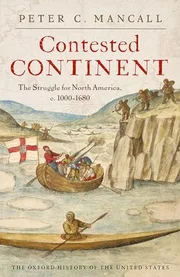

Mancall, a historian at the University of Southern California, points out that Europeans looked on Columbus’ New World as a “vacant, pristine wilderness.” Jaws may drop when he adds that it contained as many residents as Europe, more than 50 million people, and was dense with farms, towns, cultures, commerce, and civilizations that rose and vanished. After a nod to the Vikings, he summarizes European experience in the centuries after Columbus, dominated by Spain, which focused on Central and South America and the West Indies as well as emphasized exploitation over settlement. As citizens of Europe’s superpower, the French preferred to stay home. Despite occupying half of North America for two centuries after Columbus, only 70,000 were present when the British, a million strong, took over in 1763. Unlike rulers of Spain and Portugal, English monarchs hated spending government money on New World settlements, so theirs were privately financed commercial ventures. One third of the way into his long book, Mancall enters familiar territory: the settling of the Atlantic coast beginning with Roanoke in the 1570s (a disaster), Jamestown in 1607 (a horror for the first years; almost everyone died), and the Pilgrims in 1620 Massachusetts (they suffered greatly but, deeply pious, believed it was God’s plan). Nearly 500 pages describing 17th century North America deliver far more details than school history texts—and in far superior prose. Ending in 1680 seems arbitrary, until the author emphasizes that, around this period, Indigenous cultures were caught up in bloody uprisings. Indigenous peoples still vastly outnumbered Europeans, but Mancall makes a case that these events marked the tipping point when Europeans began moving into the interior in force, a process taken up in succeeding volumes.