
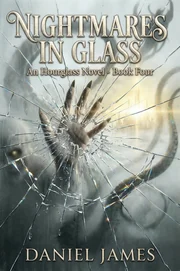

Clyde Williams, still haunted by his past in the Median—the mutable world of sleep and spirit—must descend once more into that realm to stop the Weaver from devouring consciousness itself. His fellow Hourglass agents Nat, Ace, and Rose mount their own desperate incursion through “holes…dug through the fabric of reality,” facing warped terrains where nightmares take physical form. The story’s emotional center is a man driven by remorse and devotion, his resolve echoing in a quiet promise: “The sooner I go to sleep, the sooner I can wake up.” His descent through the Median, a liminal dream world threaded with psychic architecture and ancient politics, brings him face-to-face with a reflection that stares back through a “mirror of broken glass,” wearing scars like trophies. Meanwhile, the ensemble around him—his furious mentor, his spectral comrades, his lover whose power hums to the rhythm of music—fight their own battles in splintered realities. One of Rose’s lines (“The dreams are in charge now, right? When else will I get the chance to try this?”) captures both the absurdity and bravery of their situation. Elsewhere, a sequence on an alien world shows the author’s flair for grotesque detail: “The vilgix didn’t need further encouragement. It left the cage like a racehorse leaving the gate, filament-thin tentacles latching onto the back of the pilsk’s ridged head.” Overall, the prose balances pulp energy with lyric intensity. Scenes of horror (“Darryl’s flayed face slowly slid down the plastic sheeting”) collide with passages of philosophical weight, as characters wrestle with whether redemption is even possible after so much destruction. By the time the dream world begins to collapse, the story has become both a spectacle and a confession.