
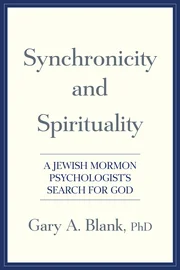

“The decision I made in 1992 to be baptized as a member of The Church of Jesus Christ of Latter-day Saints was not a particularly popular one among my Jewish family,” writes Blank in his introduction. In these pages, the author discusses events from his own spiritual journey while offering broader reflections on faith from the perspective of a licensed clinical psychologist. The volume begins with a look at Blank’s Jewish heritage; the author describes his father’s escape from Nazi occupied Sighet, Hungary, and his mother’s equally harrowing flight from Soviet pogroms in her Russian village (they eventually settled in the Bronx). As committed Jews, the couple ensured that Blank attended Hebrew school while growing up. The author attributes a chance encounter with Holocaust survivor and humanitarian Elie Wiesel with helping to inspire Blank’s lifelong endeavor to help people through psychology, but reveals that while Judaism made intellectual sense to him, it wasn’t until Blank stepped into an LDS church that he felt an irresistible spiritual call. In describing his conversion to Mormonism, the author offers religious commentary that explores the faiths’ notable differences and similarities. In doing so, he provides a primer on LDS theology, noting the belief that Mormons are spiritual “members of the house of Israel.” Blank goes on to connect his conversion to the Jungian psychological concept of synchronicity, asserting that the major turning points in his life were “manifested by [him] being in the right place at the right time.” The work also serves as a self-help guide to spiritual fulfillment as the author explores the ways in which the intersection of LDS theology and psychology may help readers find meaning. The unique narrative about a Jew who converted to Mormonism is compelling and well written, though non-LDS readers may be put off by some of Blank’s theological claims, such as the assertion that Jews are “naively disconnected from God’s true power.”