
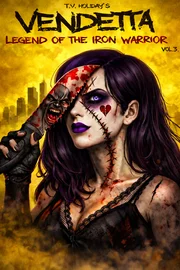

God and Luc (the Devil) have waged war across seven battlefields for centuries. The final battlefield is the city of Carnage Coast, where God’s “champions” face off against Luc’s minions. Travis Holiday, known publicly as the armor-donning Iron Warrior, is one such champion. However, after enduring darkness in his own soul, he’s been largely absent for two years. He rushes back to Carnage Coast when he receives word that the enemy may be too much for Sgt. Rebecca Walters and costumed heroes like Grenade and the Pink Jaguar to handle. The city’s biggest threat seems to come from Candace Loveless, who’s apparently dead seton exposing the Iron Warrior’s true identity. Loveless’ agenda entails kidnapping and even killing innocent people to coerce Travis into submission. Soon, a series of rumors, letters, and videos cast Travis in a bad light, making his allies believe he’s dirty and convincing his girlfriend, Crystal, that he’s cheating on her. While some of what’s being said or shown has elements of truth (Travis’ past does indeed mingle with those of a few villains), the rest is absolutely fabricated, or so Travis claims; surely, this is all part of Loveless’ diabolical plan to turn everyone Travis loves against him. In the meantime, Rebecca and the other heroes clash with assorted villains, including the Simpleton and the mesmerizing Hypnotion. As the good guys rally to keep citizens safe, the threat remains that Loveless will pick one of Travis’ allies as the next abductee in her relentless mission to hurt the Iron Warrior.
A light but unmistakable Christian theme runs throughout Holiday’s novel (and series as a whole). The Iron Warrior is characterized as “God’s fist in the war” and a man “powered by faith.” This particular installment, however, doesn’t go much deeper; Travis primarily fights opponents to assist his fellow superheroes or for personal reasons, with no indication that a divine force is driving him. He asserts that his faith is rock solid (it genuinely fuels his superpowers), but he questions it throughout the story. (“I’ve been resorting to other beliefs. I don’t know what’s right or wrong anymore.”) The narrative teems with colorful heroes and villains: Grenade, who’s married to the Pink Jaguar, wears a yellow mechanized gauntlet; masked bad guy Diversion seemingly clones himself, and each version of himself is a different hue. Candace’s scheme against Travis is frighteningly plausible; characters instantly believe that a video showing Travis in a compromising position is legit, despite how easy it is to fake such images. This all results in a welcome vulnerability for Travis, whose Iron Warrior armor appears indestructible. As Travis struggles with handling anger and occasionally turns violent, Loveless’ machinations provide a potent reminder that the superhero is only human. The dialogue is generally straightforward and refreshingly concise, but the one-liners that invariably pop up in the action scenes usually fall flat, as in the Simpleton’s taunt: “Damn, guy! Looks like you got hit by a parked car…It should’ve looked where it was going, am I right?” This third series entry makes it clear where the next installment (and planned conclusion) will go.