
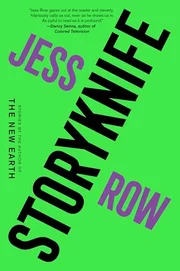

Introducing the main characters of “The Axe,” the narrator—omniscient, omnipotent, and jaded—suddenly pauses: “But none of that matters, because these aren’t real people, and it’s hard enough to hold onto your own memories without holding onto theirs.” Some of Row’s characters are aware that they’re characters; some of his narrators struggle against the constraints of their own roles. (“None of these details are accurate, by the way,” says the first-person narrator of “The Sliding Door,” midscene.) Stories that don’t explicitly satirize or deconstruct literary or literary-world conventions (see “Meditation for a Small Audience” or “Reading Group Guide”) explore storytelling, meaning-making, representation, in other ways: In “Late Blues,” two women contend with the legacy of a Black quiltmaker whose work was revered. In “Young Adult,” a pair of teenagers engineer and then livestream robot sex. Throughout all this, Row references Beckett, Lukács, Marshall McLuhan, and other literary theorists, but also seems to emphasize the ultimate futility—the tedium, really—of all that theorizing about something we seem unable to finally quit. We go on telling stories—in books, at the dinner table, to ourselves. This is implied by the very fluidity of Row’s prose: Even as he (or his narrators) perform a kind of ironic detachment—“As if what happens to me matters to anyone else except to flatter their own better judgment. The story is arrogant; the story is an elaborate inside joke”—you can’t stop reading. In other words, Row’s storytelling is masterful even as he tears down the very tropes that stories are defined by. Some stories are stronger than others (“Dear Yale” feels particularly bloodless), but as a whole, the book is brilliantly conceived and executed.