
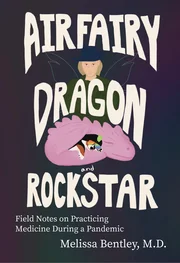

Bentley explores the difficult reality of being a doctor during the Covid pandemic: “The health care system, the people in it providing the care, were stretched beyond capacity.” While the story follows Bentley’s treatment of an array of patients, the larger tale is the author’s excessive self-criticism. Working herself to the bone, Bentley relied on survival strategies to get her through tough days. Her dog, Rockstar, comforted her at home, and Dragon, her dictation device, helped her make sense of her patients’ cases. Yet Bentley’s primary coping mechanism—the titular Air Fairy—caused her harm, even as it temporarily allowed her to center her patients’ medical struggles. Coined by her psychologist, Dr. Hardy, the Air Fairy is a personification of self-reproach: a trauma-rooted survival tactic (albeit a maladaptive one) that routinely encouraged Bentley to suppress her own needs. Expectedly, the Air Fairy grabbed the reins during the pandemic. Bentley relentlessly pursued possible resources for the afflicted, while the Air Fairy refused to succumb to perceived weakness: “I was a wimp…Air Fairy, ‘You should NOT be tired’…be tougher.” Bentley’s goal is noble, yet her habitual self-flagellation for choices like sipping a Diet Coke is fundamentally misguided and led to repercussions on her own health, like her rapid weight loss and resultant 1.8% body fat. Additionally, Bentley underwent abdominal and brain surgeries, though she categorized her pain as an unimportant weakness: “Air Fairy knew it. I had not paid attention to her, had failed, and clearly it was wrong.” Alongside detailing her medical work, Bentley also guides readers through formative events of her earlier life, like the gymnastics classes where her unwavering need for success was forged.
Bentley’s reflections are unflinchingly self-aware, although somewhat scattered and frustrating to parse. In terms of plot, she makes definite steps toward growth, but the ending lacks clarity and may not wholly satisfy readers—has anything changed? Does she see her story’s conclusion, told through the Air Fairy’s lens, as a punishment? The verdict is unclear, but Bentley does, at least, attempt to explore her trauma responses honestly. This forthrightness is underpinned by the memoir’s prose, which aims for lyrical but ends up somewhere along the stream-of-consciousness spectrum. The prose’s conversational tone is also, unfortunately, the story’s detriment; the informal cadence—with frequent pauses indicated by a wealth of commas—culminates with awkward phrasing and a disruption of fluidity: “the musicians too seemed to shine, until at the end, all lights were extinguished, the sound slowly fading. Then the full cathedral was pregnant with perfect silence, that lasted. Almost eerily, probably less than a minute, and yet longer, infinitely.” Similarly, Bentley later reflects, “Being small, hidden away, is not a way to avoid doing harm. To dare to think that my gift—that I have been given or can give something beautiful and healing, that the harm is in keeping it boxed away, stifled, bound, shadowed.” The book contains beautiful elements and important sentiments, but it would strike readers more powerfully if the composition were less clunky.