
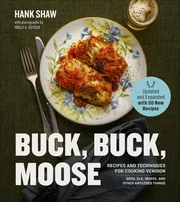

“Hank takes this stuff seriously,” hunter Randy Newberg stresses in Buck, Buck, Moose’s 10th anniversary foreword. Over nearly 300 pages of hunting stories, butchery guides, and recipes, readers will surely come to agree—Hank does take this stuff seriously. Shaw, a former restaurant cook, has made a career out of welcoming curious readers to the “wild food revolution,” starting with his 2007-founded blog Hunter Angler Gardener Cook. Ten years ago, his publication of the original Buck, Buck, Moose “changed [his] life”; now, he’s back with 30 new recipes, as well as updated guidance on contemporary cooking methods and evolving food science. His mission is the same: to address the cliche of venison cooking as a wasteful afterthought to the actual hunt, and to champion hunt-to-table cooking. The cookbook is divided into two parts: “Deer Basics” and “Deer to Table.” In the former, Shaw breaks down everything he believes a hunter-cook needs to know: the minutiae of deer anatomy, food safety and proper cooling of the carcass, including why you should have a syringe at the ready in case you have to deal with “a really full bladder.” The heart of the book—the “Deer to Table” recipes—is subdivided into eight further parts, starting with meat marinades, stocks, and bone broths and extending to meals made with deer organs (“wobbly bits”) and the complex process of making homemade sausage. Shaw makes room for the classics here, with recipes for Steak Diane and liver and onions, but, inspired by the fact that people all over the world eat some form of venison, the author also delivers an impressive array of global dishes: Vietnamese shaking venison, Ghanaian palava, Sichuan heart stir-fry, and a Thai Massaman curry. Meat, of course, is the star of the show, but the author is equally focused on the delights of a good pan sauce or a pierogi dough. Stray tidbits of culinary history and cultural context work their way into Shaw’s thoughtful recipe introductions, and he repeatedly credits fellow hunters and chefs.
This is a book of great ideological passion. Shaw’s tone is pragmatic, grounded, and accessible, but he doesn’t let that temper his singular focus on the near-spiritual act of approaching venison as a hunter-cook. He’s adamant about the sustainability and humanity of wild game hunting, and the sheer breadth of practically applicable knowledge is dizzying. Despite the author’s best efforts, the book isn’t completely exhaustive; no single book can be, as he acknowledges in the list of selected recommended reading near the book’s appendix. Novice hunters and butchers may struggle to follow Shaw’s written instructions, which often lack diagrams. Random quotes with deer themes distract slightly from the subject matter: It doesn’t help Shaw’s excellent material, for instance, to know that Rainer Maria Rilke once wrote: “You run like a herd of luminous deer, and I am dark; I am forest.” Full-color photographs by Holly A. Heyser, Shaw’s former partner, are at times instructive (one series of images shows how to wrap homemade deer meatballs with the animal’s own caul fat), but they primarily serve to tempt the reader: Shaw’s sumptuous descriptions of grilled heart with peppers glisten enticingly on the plate.