
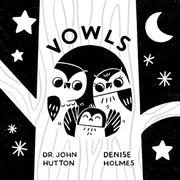

Although it’s “Day,” baby owl wants to “Play.” Mother owl tries to spoon-feed baby owl. “Ahh…” Such is the pattern set in this primer on early speech sounds, which devotes a two-page spread to each of the vowels; the hard vowel sound is exemplified on the left-hand page and the soft vowel sound on the right. Baby owl flaps out of the bassinet: “Oh. No.” Mother owl says “Stop,” but baby owl wants to “Hop! Hop!” Baby owl says “Hi!” and is gathered up for snuggles. “KISS kiss kiss!” Father owl points to the bassinet: “You.” Mother owl indicates a larger bed next to it: “Us.” All three owls go to sleep and later wake up for a night flight. Hutton, a pediatrician whose research specialty is the effect of home reading environments on early brain development, tells the owls’ tale with single-syllable utterances that capture the 10 primary vowel sounds and charmingly evoke the hoots and twitters of owls. The narrative may feel choppy—almost perfunctory—to older readers, but the author has selected the “science-based sounds” to benefit young minds. Holmes’ black-and-white illustrations present the owls as a loving family of three and engagingly include various objects with single vowel sounds (bag, cap, glass, egg, clock, blocks, fish, boots, drum) for readers to discover.